The Annunciation
Virtue: Humility
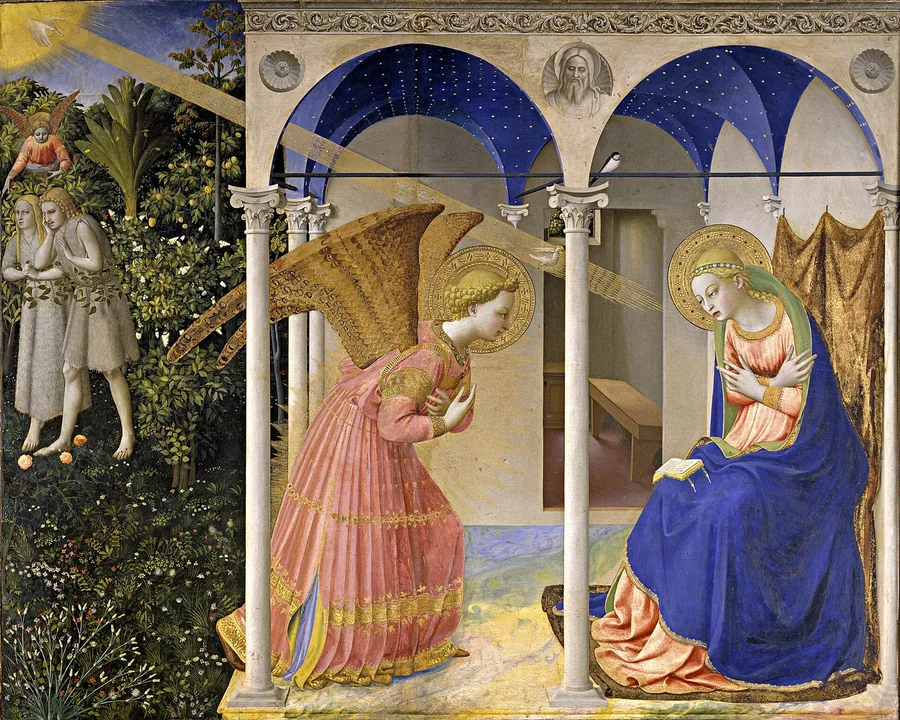
“And Mary said: Behold the handmaid of the Lord: be it done to me according to thy word. And the angel departed from her.”Luke 1:38
Gabriel finds a young girl of Nazareth going about her ordinary day, and God waits for her answer. Mary does not understand everything, yet she trusts and says yes. As you pray this decade, ask for the grace to answer God's invitation in your own life with the same trust.
How to pray this decade
Announce: The First Joyful Mystery: The Annunciation
Our Father
Our Father who art in heaven,
hallowed be thy name.
Thy kingdom come.
Thy will be done
on earth, as it is in heaven.
Give us this day
our daily bread,
and forgive us our trespasses,
as we forgive those who trespass against us,
and lead us not into temptation,
but deliver us from evil.
Amen.
Hail Mary — pray 10 times
Hail, Mary, full of grace,
the Lord is with thee.
Blessed art thou among women
and blessed is the fruit of thy womb, Jesus.
Holy Mary, Mother of God,
pray for us sinners,
now and at the hour of our death.
Amen.
Glory Be
Glory be to the Father
and to the Son
and to the Holy Spirit,
as it was in the beginning
is now, and ever shall be
world without end. Amen.
Optional: Fatima Prayer
O my Jesus, forgive us our sins, save us from the fires of hell; lead all souls to Heaven, especially those who have most need of your mercy.
Full guide →Go deeper
Luke 1:26–38
Read the passage
26And in the sixth month, the angel Gabriel was sent from God into a city of Galilee, called Nazareth,
27To a virgin espoused to a man whose name was Joseph, of the house of David: and the virgin's name was Mary.
28And the angel being come in, said unto her: Hail, full of grace, the Lord is with thee: blessed art thou among women.
29Who having heard, was troubled at his saying and thought with herself what manner of salutation this should be.
30And the angel said to her: Fear not, Mary, for thou hast found grace with God.
31Behold thou shalt conceive in thy womb and shalt bring forth a son: and thou shalt call his name Jesus.
32He shall be great and shall be called the Son of the Most High. And the Lord God shall give unto him the throne of David his father: and he shall reign in the house of Jacob for ever.
33And of his kingdom there shall be no end.
34And Mary said to the angel: How shall this be done, because I know not man?
35And the angel answering, said to her: The Holy Ghost shall come upon thee and the power of the Most High shall overshadow thee. And therefore also the Holy which shall be born of thee shall be called the Son of God.
36And behold thy cousin Elizabeth, she also hath conceived a son in her old age: and this is the sixth month with her that is called barren.
37Because no word shall be impossible with God.
38And Mary said: Behold the handmaid of the Lord: be it done to me according to thy word. And the angel departed from her.
Matthew 1:18–25
Joseph's account: the child is conceived of the Holy Spirit and named Jesus.
Linked by: CCC 497
Read the passage
18Now the generation of Christ was in this wise. When as his mother Mary was espoused to Joseph, before they came together, she was found with child, of the Holy Ghost.
19Whereupon Joseph her husband, being a just man, and not willing publicly to expose her, was minded to put her away privately.
20But while he thought on these things, behold the Angel of the Lord appeared to him in his sleep, saying: Joseph, son of David, fear not to take unto thee Mary thy wife, for that which is conceived in her, is of the Holy Ghost.
21And she shall bring forth a son: and thou shalt call his name Jesus. For he shall save his people from their sins.
22Now all this was done that it might be fulfilled which the Lord spoke by the prophet, saying:
23Behold a virgin shall be with child, and bring forth a son, and they shall call his name Emmanuel, which being interpreted is, God with us.
24And Joseph rising up from sleep, did as the angel of the Lord had commanded him, and took unto him his wife.
25And he knew her not, till she brought forth her first born son: and he called his name Jesus.
John 1:14
'The Word became flesh': the Church calls this the Incarnation, the mystery that opens at the Annunciation.
Read the passage
14And the Word was made flesh and dwelt among us (and we saw his glory, the glory as it were of the only begotten of the Father), full of grace and truth.
Hebrews 10:5–10
'A body you have prepared for me': Christ's offering at his coming into the world, read on the Annunciation.
Linked by: Roman Lectionary (Australian edition): Annunciation (25 Mar), 2nd reading Heb 10:4-10 · CCC 488
Read the passage
5Wherefore, when he cometh into the world he saith: Sacrifice and oblation thou wouldest not: but a body thou hast fitted to me.
6Holocausts for sin did not please thee.
7Then said I: Behold I come: in the head of the book it is written of me: that I should do thy will, O God.
8In saying before, Sacrifices, and oblations, and holocausts for sin thou wouldest not, neither are they pleasing to thee, which are offered according to the law.
9Then said I: Behold, I come to do thy will, O God: He taketh away the first, that he may establish that which followeth.
10In the which will, we are sanctified by the oblation of the body of Jesus Christ once.
Isaiah 7:14
The virgin who conceives and bears Emmanuel ('God with us') is read by the Church as fulfilled in Mary.
Linked by: Roman Lectionary (Australian edition): Annunciation (25 Mar), 1st reading Is 7:10-14 · Lumen Gentium 55 (Vatican II) · CCC 497
Read the passage
14Therefore the Lord himself shall give you a sign. Behold a virgin shall conceive, and bear a son and his name shall be called Emmanuel.
Genesis 3:15
The promise of a woman's offspring who will crush the serpent is read as the first announcement of the Saviour and of Mary's place beside him.
Linked by: Lumen Gentium 55 (Vatican II) · CCC 489
Read the passage
15I will put enmities between thee and the woman, and thy seed and her seed: she shall crush thy head, and thou shalt lie in wait for her heel.
Zephaniah 3:14–17
'Rejoice, daughter of Zion... the Lord is in your midst': the Catechism hears in it the angel's greeting 'Rejoice' to Mary, in whom God comes to dwell.
Read the passage
14Give praise, O daughter of Sion: shout, O Israel: be glad, and rejoice with all thy heart, O daughter of Jerusalem.
15The Lord hath taken away thy judgment, he hath turned away thy enemies: the king of Israel, the Lord, is in the midst of thee, thou shalt fear evil no more.
16In that day it shall be said to Jerusalem: Fear not: to Sion: Let not thy hands be weakened.
17The Lord thy God in the midst of thee is mighty, he will save: he will rejoice over thee with gladness, he will be silent in his love, he will be joyful over thee in praise.
Psalm 40:6–10 (Douay: Psalm 39:7–11)
'Here am I, Lord; I come to do your will': the responsorial psalm of the Annunciation, whose words Hebrews 10:5-7 puts on the lips of Christ as he comes into the world.
Read the passage
7Sacrifice and oblation thou didst not desire; but thou hast pierced ears for me. Burnt offering and sin offering thou didst not require:
8Then said I, Behold I come. In the head of the book it is written of me
9That I should do thy will: O my God, I have desired it, and thy law in the midst of my heart.
10I have declared thy justice in a great church, lo, I will not restrain my lips: O Lord, thou knowest it.
11I have not hid thy justice within my heart: I have declared thy truth and thy salvation. I have not concealed thy mercy and thy truth from a great council.
“And thus also it was that the knot of Eve's disobedience was loosed by the obedience of Mary. For what the virgin Eve had bound fast through unbelief, this did the virgin Mary set free through faith.”
“The angel awaits your reply, for it is time that he should return to God, Who sent him. We, too, are waiting, O Lady, for a word of mercy — we, who are groaning under the sentence of condemnation.”
“Answer the word, receive the Word. Utter yours, conceive the Divine. Speak the word that is transitory, and embrace the Word that is everlasting.”
“Therefore Mary is more blessed in receiving the faith of Christ, than in conceiving the flesh of Christ. … Thus also her nearness as a Mother would have been of no profit to Mary, had she not borne Christ in her heart after a more blessed manner than in her flesh.”
“This is clear from the very first mystery, the Annunciation, where Gabriel's greeting to the Virgin of Nazareth is linked to an invitation to messianic joy: “Rejoice, Mary”. The whole of salvation history, in some sense the entire history of the world, has led up to this greeting. If it is the Father's plan to unite all things in Christ (cf. Eph 1:10), then the whole of the universe is in some way touched by the divine favour with which the Father looks upon Mary and makes her the Mother of his Son.”
“The Annunciation … is a humble, hidden event - no one saw it, no one except Mary knew of it -, but at the same time it was crucial to the history of humanity. When the Virgin said her "yes" to the Angel's announcement, Jesus was conceived and with him began the new era of history that was to be ratified in Easter as the "new and eternal Covenant".”
“The Eternal Son of God stoops to mankind, putting on its nature; but with the assent of Mary, who conceives Him by the Holy Ghost.”
CCC 484
The Annunciation opens the fullness of time
Read the paragraph
The Annunciation to Mary inaugurates "the fullness of time", the time of the fulfillment of God's promises and preparations. Mary was invited to conceive him in whom the "whole fullness of deity" would dwell "bodily". The divine response to her question, "How can this be, since I know not man?", was given by the power of the Spirit: "The Holy Spirit will come upon you."
CCC 490
Mary 'full of grace', chosen to be Mother of the Saviour
Read the paragraph
To become the mother of the Savior, Mary "was enriched by God with gifts appropriate to such a role." The angel Gabriel at the moment of the annunciation salutes her as "full of grace". In fact, in order for Mary to be able to give the free assent of her faith to the announcement of her vocation, it was necessary that she be wholly borne by God's grace.
CCC 494
Mary's fiat: the obedience of faith
Read the paragraph
At the announcement that she would give birth to "the Son of the Most High" without knowing man, by the power of the Holy Spirit, Mary responded with the obedience of faith, certain that "with God nothing will be impossible": "Behold, I am the handmaid of the Lord; let it be [done] to me according to your word." Thus, giving her consent to God's word, Mary becomes the mother of Jesus. Espousing the divine will for salvation wholeheartedly, without a single sin to restrain her, she gave herself entirely to the person and to the work of her Son; she did so in order to serve the mystery of redemption with him and dependent on him, by God's grace:
As St. Irenaeus says, "Being obedient she became the cause of salvation for herself and for the whole human race." Hence not a few of the early Fathers gladly assert. . .: "The knot of Eve's disobedience was untied by Mary's obedience: what the virgin Eve bound through her disbelief, Mary loosened by her faith." Comparing her with Eve, they call Mary "the Mother of the living" and frequently claim: "Death through Eve, life through Mary."
CCC 497
The virginal conception by the Holy Spirit
Read the paragraph
The Gospel accounts understand the virginal conception of Jesus as a divine work that surpasses all human understanding and possibility: "That which is conceived in her is of the Holy Spirit", said the angel to Joseph about Mary his fiancee. The Church sees here the fulfillment of the divine promise given through the prophet Isaiah: "Behold, a virgin shall conceive and bear a son."